
If you’ve been doing SEO for a while, you’ve probably heard mixed opinions about Web 2.0 backlinks.
Some marketers still use them aggressively. Others call them outdated spam.
The truth in 2026 is somewhere in the middle.
At VP DigiWeb, we’ve tested Web 2.0 submissions across local SEO campaigns, affiliate projects, Shopify stores, and service-based business websites in India. When used strategically, Web 2.0 sites can still help with:
- Faster indexing
- Building topical relevance
- Diversifying backlink profiles
- Supporting tier-2 link building
- Strengthening brand entity signals
But they only work when paired with quality content and real SEO strategy.
Google’s algorithms are now much better at identifying spammy link patterns, mass-generated AI content, and low-quality backlink networks. Multiple industry studies and recent SEO discussions confirm that low-quality Web 2.0 spam no longer delivers sustainable rankings.
In this detailed guide, Vicky Patel shares:
- What Web 2.0 submission sites are
- Whether Web 2.0 backlinks still work in 2026
- How we use them safely for Indian SEO campaigns
- Best Web 2.0 submission sites list
- Dofollow Web 2.0 sites
- High DA Web 2.0 sites
- Mistakes to avoid
- Advanced Web 2.0 backlink strategy
What Are Web 2.0 Submission Sites?
Web 2.0 sites are platforms that allow users to create and publish their own content for free.
Unlike static websites, these platforms support:
- User-generated blogs
- Articles
- Media publishing
- Mini websites
- Community engagement
Popular examples include:
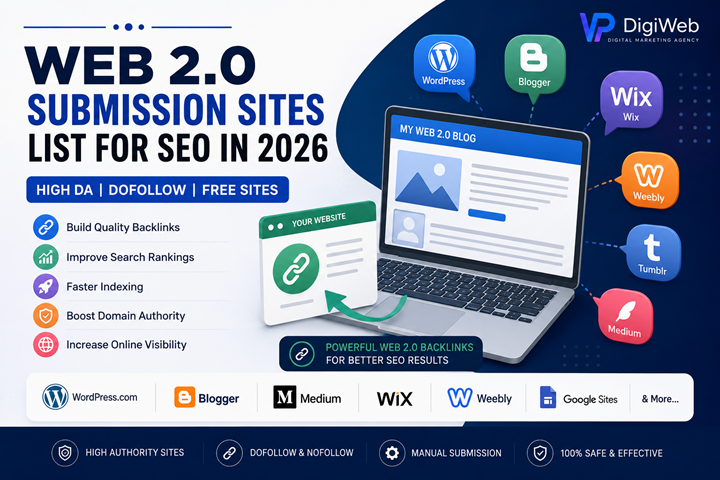
- WordPress.com
- Blogger
- Medium
- Tumblr
- Wix
- Weebly
SEO professionals use these platforms to create contextual backlinks pointing toward their main website.
Many high-authority SEO resources still list Web 2.0 submission as a relevant off-page SEO tactic when done naturally and with quality content.
Do Web 2.0 Backlinks Still Work in 2026?
Yes — but not the way they worked 10 years ago.
In 2015–2018, people ranked websites by:
- Spinning content
- Creating hundreds of Web 2.0 blogs
- Stuffing exact-match anchors
- Automating backlinks
That strategy is now risky.
Modern SEO requires:
- Genuine content
- Real topical relevance
- Branded anchor distribution
- Human-like publishing patterns
- Trust signals
Recent SEO discussions show that Web 2.0 links are mostly useful as supporting links rather than primary authority links.
Our Real Experience at VP DigiWeb
At VP DigiWeb, we tested Web 2.0 backlinks on:
- Local SEO pages
- Digital marketing service pages
- Shopify SEO projects
- AI-content-supported niche sites
What We Observed
What Worked
✅ Building branded Web 2.0 properties
✅ Publishing unique human-edited content
✅ Using niche-relevant internal linking
✅ Supporting money pages with tiered indexing
✅ Combining with guest posts and citations
✅ Keeping anchor text mostly branded
What Failed
❌ Mass-created Web 2.0 blogs
❌ AI-spun duplicate content
❌ Exact-match anchor stuffing
❌ 100+ low-quality submissions overnight
❌ Thin 300-word articles
One of our local SEO projects improved indexing speed and long-tail visibility after creating a small cluster of high-quality branded Web 2.0 properties around niche topics.
However, Web 2.0 links alone did NOT rank the website.
The biggest ranking improvements came when Web 2.0 backlinks supported:
- Guest posts
- Digital PR mentions
- Strong on-page SEO
- EEAT optimization
- Topical authority clusters
That aligns with what many experienced SEOs are reporting publicly today.
Benefits of Web 2.0 Submission Sites
1. Free Backlinks
Most Web 2.0 sites are completely free.
That makes them useful for startups, freelancers, and small businesses.
2. High Authority Domains
Platforms like:
- WordPress.com
- Medium
- Blogger
- Wix
already have strong domain authority and are crawled frequently by Google.
3. Faster Indexing
Google bots crawl major publishing platforms very frequently.
New content often gets indexed faster compared to brand-new websites.
4. Anchor Text Flexibility
Unlike directory submissions, Web 2.0 platforms allow contextual anchor placement within content.
5. Brand Entity Building
Branded Web 2.0 profiles can strengthen your overall online footprint.
This is especially useful for:
- Local businesses
- Agencies
- Personal brands
- Ecommerce stores
Best Web 2.0 Submission Sites List (High DA)
Below are some of the best free Web 2.0 sites for backlinks in 2026.
| Web 2.0 Site | Type | Approx Authority | Link Type |
|---|---|---|---|
| WordPress.com | Blogging | Very High | Mixed |
| Blogger.com | Blogging | Very High | Dofollow/Natural |
| Medium.com | Publishing | Very High | Mostly Nofollow |
| Tumblr.com | Microblogging | High | Mixed |
| Wix.com | Website Builder | High | Dofollow |
| Weebly.com | Website Builder | High | Dofollow |
| Google Sites | Website Builder | Very High | Dofollow |
| Jimdo.com | Website Builder | Medium-High | Mixed |
| Webnode.com | Website Builder | Medium-High | Mixed |
| LiveJournal.com | Blogging | Medium | Mixed |
| Strikingly.com | Website Builder | Medium | Mixed |
| Site123.com | Website Builder | Medium | Mixed |
| Substack.com | Publishing | High | Mixed |
| Telegra.ph | Publishing | High | Dofollow |
| Typepad.com | Blogging | High | Mixed |
The platforms above consistently appear across updated SEO resources and active Web 2.0 lists.
Free Web 2.0 Submission Sites List
Here are additional free Web 2.0 blog sites commonly used by SEO professionals:
- Edublogs.org
- Bravenet.com
- Yola.com
- Webs.com
- Ucoz.com
- Jigsy.com
- Over-blog.com
- Blogsome.com
- Wikidot.com
- Minds.com
- TravelBlog.org
- Hatenablog.com
Dofollow Web 2.0 Sites
Many marketers specifically search for dofollow Web 2.0 sites.
However, focusing ONLY on dofollow links is a mistake.
A natural backlink profile includes:
- Dofollow links
- Nofollow links
- UGC links
- Branded mentions
That said, commonly reported dofollow-friendly Web 2.0 platforms include:
- Blogger
- Google Sites
- Wix
- Weebly
- Webnode
- Yola
- Telegra.ph
How We Build Web 2.0 Backlinks Safely
Step 1: Create a Branded Profile
Avoid keyword-stuffed usernames.
Good example:
- vpdigiwebmarketing.wordpress.com
Bad example:
- bestseocompanymumbai.wordpress.com
Step 2: Publish Real Content
Every Web 2.0 property should contain:
- Original images
- Human-edited content
- Internal links
- Proper formatting
- Relevant outbound references
Step 3: Build Topical Relevance
Instead of random articles, create a mini topical cluster.
Example for SEO niche:
- Technical SEO
- Local SEO
- Ecommerce SEO
- AI SEO
- Link building
Step 4: Use Natural Anchors
Best anchor distribution:
- 70% branded
- 20% partial match
- 10% generic
Avoid excessive exact-match anchors.
Step 5: Index Slowly
Publishing 50 Web 2.0 blogs in one day creates an unnatural footprint.
Natural velocity matters.
Common Mistakes to Avoid
Using AI-Spun Content
Google is increasingly effective at identifying scaled low-quality content.
Building Only Web 2.0 Links
Web 2.0 links alone rarely rank competitive keywords anymore.
You still need:
- Authority backlinks
- PR mentions
- Strong content
- Technical SEO
Exact Match Anchor Spam
This is still one of the biggest reasons websites get algorithmically suppressed.
Ignoring Content Quality
Thin pages without engagement signals have little SEO value.
Are Web 2.0 Sites Good for Tier-2 SEO?
Yes.
This is where Web 2.0 backlinks still work best today.
At VP DigiWeb, we mostly use them for:
- Tier-2 link support
- Indexing support
- Entity reinforcement
- Supporting branded content
Rather than pointing large quantities directly to money pages.
This matches broader SEO industry sentiment around safer modern usage.
Web 2.0 Backlinks vs Guest Posts
| Factor | Web 2.0 Links | Guest Posts |
|---|---|---|
| Cost | Free | Paid/Outreach |
| Authority | Medium | High |
| Risk | Medium | Lower |
| Scalability | High | Medium |
| Trust Signals | Lower | Strong |
| Traffic Potential | Low-Medium | High |
| EEAT Value | Limited | Strong |
Our experience:
- Guest posts drive stronger rankings
- Web 2.0 links help diversify profiles
- Both work best together
Are High DA Web 2.0 Sites Enough to Rank?
No.
Many beginners misunderstand Domain Authority.
Google does NOT use Moz DA directly as a ranking factor.
A weak article on a DA 95 platform still may not rank.
Topical relevance, content quality, backlinks, and user engagement matter far more. Discussions within the SEO community continue to reinforce this point.
Final Verdict: Should You Use Web 2.0 Submission Sites?
Yes — but strategically.
Web 2.0 backlinks still have value in 2026 when used for:
- Brand diversification
- Supporting backlinks
- Tier-2 SEO
- Faster indexing
- Topical support
But they are NOT a replacement for:
- Digital PR
- Guest posting
- EEAT content
- Real authority backlinks
At VP DigiWeb, we use Web 2.0 submissions as one layer inside a broader SEO ecosystem — not as the entire strategy.
The best SEO results always come from:
- Strong content
- Topical authority
- Real brand trust
- Quality backlinks
- Consistent publishing
FAQs
What are Web 2.0 submission sites?
Web 2.0 submission sites are platforms where users can publish blogs, articles, or websites and create backlinks to their own sites.
Are Web 2.0 backlinks safe?
They are generally safe when created naturally with quality content and proper anchor usage.
Do Web 2.0 backlinks still work in 2026?
Yes, but mostly as supporting or tier-2 backlinks rather than primary ranking links.
Which are the best Web 2.0 sites for backlinks?
Popular options include:
- WordPress.com
- Blogger
- Medium
- Wix
- Google Sites
- Tumblr
Are all Web 2.0 links dofollow?
No. Many platforms use mixed or nofollow attributes.
How many Web 2.0 backlinks should I create?
Focus on quality over quantity. A few strong branded properties work better than hundreds of spammy blogs.
Reviewed by: Vicky Patel – SEO Specialist & Founder of VP DigiWeb with 9+ years of experience in SEO and digital marketing.