
Search engine optimization has changed dramatically over the last few years. Earlier, websites could rank by repeating the same keyword multiple times on a page. Today, Google understands entities, context, search intent, semantic relationships, and topical relevance.
That is why modern SEO is no longer only about keywords. It is about building topical authority, satisfying user intent, and creating content that fully answers a query.
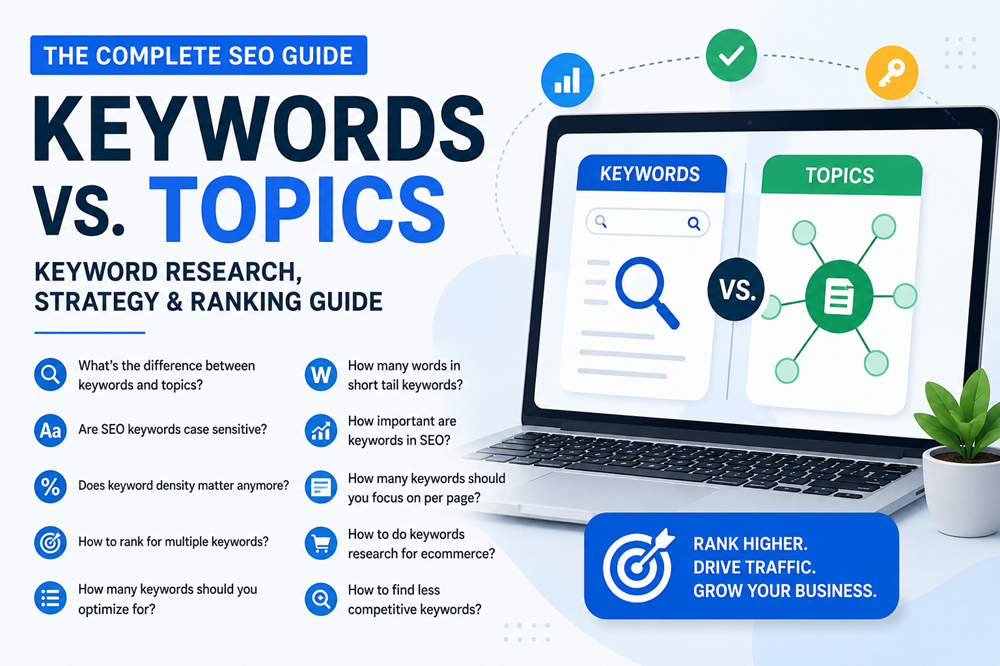
In this detailed guide, we will cover:
- What is the difference between keywords and topics?
- Are SEO keywords case sensitive?
- Does keyword density matter anymore?
- How to rank for multiple keywords
- How many keywords should you optimize for?
- How important are keywords in SEO?
- How to do keyword research for ecommerce websites
- How to find low competition keywords
- Modern topical authority strategy for AI search and Google rankings
This guide is based on modern SEO practices, semantic search principles, ecommerce SEO experience, and topical authority strategies used by leading SEO professionals in 2026.
What Is the Difference Between Keywords and Topics?
One of the biggest misunderstandings in SEO is assuming keywords and topics are the same thing.
They are connected, but they are not identical.
What Are Keywords?
Keywords are the actual words or phrases users type into search engines.
Examples:
- best seo company in Mumbai
- keyword research tools
- ecommerce seo checklist
- how to improve website rankings
Keywords represent specific search queries.
What Are Topics?
Topics are broader subject areas that include multiple related keywords, entities, questions, and user intents.
For example:
Topic: Keyword Research
This topic may include:
- how to do keyword research
- keyword research tools
- long tail keywords
- keyword difficulty
- keyword clustering
- ecommerce keyword research
- informational keywords
- transactional keywords
- low competition keywords
A topic contains many semantically related searches.
Why Topics Matter More Today
Google now understands:
- semantic relationships
- entities
- contextual meaning
- topical depth
- user intent
This means a page can rank for hundreds or thousands of keywords even without exact-match optimization.
For example, a well-written guide about ecommerce keyword research may rank for:
- ecommerce keyword research
- keyword research for online store
- Shopify SEO keywords
- product page keywords
- low competition ecommerce keywords
- buyer intent keywords
without targeting each phrase individually.
Keywords vs Topics: Key Difference
| Keywords | Topics |
|---|---|
| Specific search phrases | Broad subject areas |
| Individual queries | Collection of related concepts |
| Used for optimization | Used for authority building |
| Target search demand | Build semantic relevance |
| Often short-term | Long-term SEO strategy |
Modern SEO Uses Both
Modern SEO combines:
- Keyword targeting
- Topic clustering
- Semantic optimization
- Internal linking
- Search intent mapping
The best-performing websites do not publish random keyword-focused pages anymore.
Instead, they build interconnected topic clusters.
Are SEO Keywords Case Sensitive?
No, SEO keywords are generally not case sensitive.
Google treats:
- SEO Agency
- seo agency
- Seo Agency
as the same query in most situations.
Similarly:
- Digital Marketing Company
- digital marketing company
will usually produce nearly identical search results.
Why Case Sensitivity Usually Does Not Matter
Google normalizes text during indexing and query processing.
Its algorithms understand language patterns and interpret words regardless of capitalization.
That means:
- URLs
- titles
- headings
- body content
can rank whether keywords are uppercase or lowercase.
Exceptions Where Case May Matter
There are some rare cases where capitalization changes meaning.
Examples:
- us vs US
- apple vs Apple
- polish vs Polish
In such cases, Google uses context to determine intent.
SEO Best Practice
Use capitalization for:
- readability
- branding
- professionalism
- user experience
Not for rankings.
Example:
Correct:
"Best SEO Company in Mumbai"
Not:
"BEST SEO COMPANY IN MUMBAI"
Readable content performs better for users and engagement.
Does Keyword Density Matter Anymore?
Keyword density still matters slightly for relevance, but it is no longer a primary ranking factor.
Modern SEO focuses far more on:
- search intent
- topical coverage
- semantic relevance
- content quality
- user experience
- expertise and authority
than exact keyword repetition.
What Is Keyword Density?
Keyword density refers to how often a keyword appears compared to the total word count.
Example:
If a keyword appears 10 times in a 1000-word article:
genui{"math_block_widget_always_prefetch_v2":{"content":"\text{Keyword Density} = \frac{10}{1000} \times 100 = 1%"}}
Years ago, SEOs tried to maintain exact density percentages.
That strategy is outdated.
Why Keyword Stuffing No Longer Works
Google’s algorithms now detect:
- unnatural repetition
- over-optimization
- spam signals
- poor user experience
Keyword stuffing can reduce rankings instead of improving them.
Example of keyword stuffing:
"Our SEO company provides SEO services because our SEO company is the best SEO company for SEO services."
This looks manipulative and harms readability.
What Matters More Than Density Today
Modern SEO prioritizes:
1. Search Intent Match
Does the page fully solve the user's problem?
2. Semantic SEO
Does the content include related concepts naturally?
3. Topical Coverage
Does the content comprehensively cover the subject?
4. Entity Optimization
Does Google clearly understand the subject relationships?
5. User Experience
Is the page easy to read and useful?
Ideal Keyword Usage Strategy
Instead of obsessing over density:
Use your primary keyword naturally in:
- Title tag
- URL
- H1
- Introduction
- One or two subheadings
- Meta description
- Image alt text where relevant
Then focus on semantic variations.
Example:
Primary keyword:
- keyword research
Related semantic terms:
- search intent
- keyword clustering
- topical authority
- long-tail keywords
- keyword difficulty
- semantic SEO
This creates natural topical relevance.
How to Rank for Multiple Keywords
One page can rank for multiple keywords if the search intent is closely related.
This is one of the biggest advantages of semantic SEO.
Example
A single page about "SEO company in Mumbai" may rank for:
- seo company in Mumbai
- seo agency in Mumbai
- seo services in Mumbai
- digital marketing company in Mumbai
- best seo consultant in Mumbai
because Google understands these queries are closely connected.
Step-by-Step Strategy to Rank for Multiple Keywords
1. Group Keywords by Intent
Do not create separate pages for every keyword variation.
Instead, cluster similar-intent keywords.
Example cluster:
- keyword research tools
- best keyword research tools
- seo keyword tools
- keyword planner tools
These can usually target one page.
2. Use Primary and Secondary Keywords
Structure:
Primary Keyword
Main target phrase.
Secondary Keywords
Supporting variations and semantically related terms.
Example:
Primary:
- ecommerce seo
Secondary:
- ecommerce keyword research
- product page seo
- category page optimization
- Shopify SEO
3. Cover the Topic Deeply
Google rewards completeness.
Your content should answer:
- beginner questions
- advanced questions
- comparisons
- FAQs
- examples
- strategies
- mistakes
4. Add Semantic Variations Naturally
Use:
- synonyms
- entities
- related phrases
- conversational queries
This improves contextual understanding.
5. Use Proper Internal Linking
Internal links help Google understand topical relationships.
Link:
- supporting pages
- cluster content
- service pages
- case studies
This strengthens topical authority.
6. Optimize for AI Search and Featured Snippets
Use:
- clear headings
- concise answers
- FAQ sections
- structured formatting
- schema markup
AI search systems increasingly prefer well-structured topical content.
How Many Keywords Should You Optimize For?
There is no fixed number.
The ideal approach is:
- one primary keyword
- several secondary keywords
- multiple semantic variations
- related entities and questions
for each page.
Recommended Structure
Primary Keyword
1 main keyword.
Secondary Keywords
3–10 closely related variations.
Semantic Keywords
Natural related phrases throughout the content.
Avoid These Mistakes
Targeting Too Many Unrelated Keywords
Bad example:
One page targeting:
- SEO company
- web design
- graphic design
- PPC agency
- social media marketing
This creates diluted relevance.
Creating Separate Pages for Tiny Variations
Bad example:
- seo company in Mumbai
- seo agencies in Mumbai
- best seo company Mumbai
These often belong on one strong page.
Keyword Cannibalization Problem
When multiple pages target the same intent, they compete against each other.
This is called keyword cannibalization.
It can:
- reduce rankings
- confuse Google
- split authority
- weaken internal linking
A strong topical structure prevents this issue.
How Many Words Are in Short Tail Keywords?
Short-tail keywords usually contain:
- 1 word
- 2 words
- sometimes 3 broad words
Examples:
- SEO
- SEO services
- digital marketing
- shoes
- laptops
Characteristics of Short Tail Keywords
| Feature | Short Tail Keywords |
| Search volume | Very high |
| Competition | Very high |
| Intent clarity | Broad |
| Conversion rate | Lower |
| Ranking difficulty | Hard |
Long Tail Keywords
Long-tail keywords are longer and more specific.
Examples:
- affordable seo company for startups
- best running shoes for flat feet
- ecommerce seo services for Shopify stores
Why Long Tail Keywords Matter
Long-tail keywords often:
- convert better
- have lower competition
- match specific intent
- rank faster
- attract qualified traffic
This is why modern SEO strategies combine:
- broad topical authority
- targeted long-tail keyword pages
How Important Are Keywords in SEO?
Keywords are still extremely important.
But their role has evolved.
Earlier:
SEO focused heavily on exact-match keywords.
Today:
SEO focuses on intent, context, entities, and topical authority.
Keywords Still Help Google Understand:
- page topic
- search relevance
- content context
- user intent
Without keywords, Google cannot properly interpret your content.
But Keywords Alone Are Not Enough
Modern ranking factors include:
- content quality
- E-E-A-T
- topical authority
- user experience
- backlinks
- semantic relevance
- internal linking
- site structure
- engagement signals
Modern SEO Formula
Successful SEO now combines:
Keywords
for relevance.
Topics
for authority.
Entities
for semantic understanding.
Content Quality
for user satisfaction.
Internal Linking
for topical relationships.
Backlinks
for trust.
Keywords in AI Search Era
AI search systems increasingly interpret meaning instead of exact phrases.
That means:
- semantic coverage matters more
- natural language matters more
- conversational queries matter more
- topical completeness matters more
However, keywords still provide foundational relevance signals.
How Many Keywords Should You Focus On Per Page?
For most SEO pages:
Focus on:
- 1 primary keyword
- 5–15 related secondary keywords
- multiple semantic variations
Best Practice Structure
One Core Intent Per Page
Every page should satisfy one main search intent.
Example:
Page topic:
"How to Do Ecommerce Keyword Research"
Related keywords:
- ecommerce keyword research
- Shopify keyword research
- Amazon keyword research
- product page keywords
- ecommerce SEO keywords
These are semantically connected.
Signs You Are Targeting Too Many Keywords
- content feels unfocused
- headings look random
- search intent conflicts
- page lacks topical depth
- low rankings despite optimization
Signs You Need Separate Pages
Create separate pages when:
- search intent differs significantly
- users expect different content
- SERPs show different ranking pages
- topics require unique depth
Example:
Separate pages for:
- ecommerce seo
- local seo
- technical seo
- enterprise seo
because the intent differs.
How to Do Keyword Research for Ecommerce
Ecommerce keyword research is different from regular blog SEO.
You must optimize for:
- buyer intent
- product intent
- commercial intent
- category intent
- informational intent
Step-by-Step Ecommerce Keyword Research Process
1. Start With Product Categories
Identify:
- main categories
- subcategories
- product types
- attributes
- brand modifiers
Example:
Category:
Running Shoes
Subtopics:
- men's running shoes
- women's running shoes
- trail running shoes
- lightweight running shoes
2. Analyze Search Intent
Intent matters more than volume alone.
Types:
| Intent | Example |
| Informational | how to choose running shoes |
| Commercial | best running shoes for beginners |
| Transactional | buy Nike running shoes online |
| Navigational | Nike official store |
3. Use Ecommerce Keyword Modifiers
High-converting modifiers include:
- buy
- best
- affordable
- near me
- online
- deals
- reviews
- under ₹5000
- for beginners
4. Research Competitor Keywords
Analyze competitor:
- category pages
- product pages
- blog content
- FAQs
- filters
- schema markup
Tools:
- Google Search
- Google Autocomplete
- Ahrefs
- Semrush
- Google Keyword Planner
- Search Console
5. Target Long Tail Ecommerce Keywords
Long-tail keywords convert better.
Example:
Instead of:
- shoes
Target:
- best running shoes for flat feet under ₹5000
6. Optimize Category Pages
Many ecommerce websites ignore category page SEO.
But category pages often drive massive traffic.
Optimize:
- titles
- meta descriptions
- introductory copy
- FAQs
- schema
- filters
- internal links
7. Build Topical Authority Around Products
Example:
If you sell skincare products:
Create content around:
- acne treatment
- skincare routines
- retinol guide
- sunscreen guide
- anti-aging skincare
- oily skin care tips
This improves ecommerce topical authority.
8. Use Search Console Data
Google Search Console reveals:
- hidden keyword opportunities
- impressions
- CTR gaps
- near-ranking keywords
This is one of the best ways to scale ecommerce SEO.
How to Find Less Competitive Keywords
Low competition keywords are easier to rank for, especially for newer websites.
What Makes a Keyword Low Competition?
Usually:
- lower keyword difficulty
- weaker competitors
- lower authority SERPs
- specific intent
- long-tail phrasing
Step-by-Step Process
1. Target Long Tail Keywords
Longer keywords usually have:
- lower competition
- clearer intent
- higher conversions
Example:
Instead of:
- SEO company
Target:
- affordable seo company for dentists in Mumbai
2. Use Google Autocomplete
Type a keyword into Google and analyze suggestions.
These are real user searches.
3. Analyze "People Also Ask"
Google's People Also Ask section reveals:
- question keywords
- informational opportunities
- topical gaps
4. Look for Weak SERPs
Low competition SERPs often contain:
- forum pages
- Quora results
- outdated content
- thin articles
- weak domain authority sites
These are opportunities.
5. Use Keyword Difficulty Tools
Popular tools:
- Ahrefs
- Semrush
- Ubersuggest
- Keyword Planner
- LowFruits
Analyze:
- KD score
- backlinks
- search intent
- domain authority
6. Target Local Variations
Local keywords are often less competitive.
Example:
Instead of:
- seo agency
Target:
- seo agency in Surat
- seo company in Nashik
- seo expert in Indore
7. Use Emerging Trends
Trending topics may have lower competition early.
Monitor:
- Reddit discussions
- Google Trends
- industry forums
- YouTube trends
- AI search queries
8. Build Topical Clusters
Instead of chasing isolated keywords:
Create interconnected content.
This helps smaller websites rank faster.
Topical Authority vs Traditional Keyword SEO
Modern SEO increasingly favors topical authority.
Traditional SEO Approach
Old SEO focused on:
- exact match keywords
- keyword density
- isolated pages
- backlinks only
Modern Topical Authority Approach
Today SEO focuses on:
- semantic search
- topic clusters
- search intent
- entity optimization
- user satisfaction
- topical completeness
Example of Topical Authority
Instead of publishing one article about SEO:
Build an SEO content cluster:
Pillar Page
- Complete SEO Guide
Cluster Pages
- keyword research
- technical SEO
- on-page SEO
- off-page SEO
- local SEO
- ecommerce SEO
- link building
- semantic SEO
- topical authority
Supporting Content
- case studies
- FAQs
- checklists
- tutorials
- comparisons
This structure helps Google understand expertise.
Common Keyword Research Mistakes
1. Chasing Only High Volume Keywords
High volume often means:
- higher competition
- lower conversions
- slower rankings
2. Ignoring Search Intent
Intent mismatch destroys rankings.
3. Keyword Stuffing
Over-optimization reduces quality.
4. Ignoring Internal Linking
Topical relationships matter.
5. Creating Thin Content
Google rewards depth and completeness.
6. Ignoring Semantic SEO
Modern SEO requires contextual relevance.
7. Not Updating Content
Freshness matters in many industries.
Best SEO Keyword Research Tools
Popular keyword research tools include:
- Google Keyword Planner
- Ahrefs
- Semrush
- Ubersuggest
- LowFruits
- AnswerThePublic
- Google Search Console
- Google Trends
- AlsoAsked
Each tool helps discover:
- search volume
- keyword difficulty
- intent
- trends
- semantic variations
- content opportunities
Final Thoughts
SEO has evolved far beyond repeating keywords.
Modern search engines understand:
- context
- intent
- entities
- semantic relationships
- topical depth
Keywords still matter because they help search engines understand relevance.
But rankings today depend far more on:
- topical authority
- helpful content
- semantic SEO
- internal linking
- search intent satisfaction
- E-E-A-T signals
The best SEO strategy now combines:
- smart keyword targeting
- topic clustering
- semantic optimization
- comprehensive content
- user-first writing
Websites that build topical authority consistently outperform websites that rely only on outdated keyword tactics.
As AI search, Google AI Overviews, and semantic search continue evolving, topical depth and expertise will become even more important for long-term rankings.
Frequently Asked Questions
Are keywords still important in SEO?
Yes. Keywords still help search engines understand content relevance, but modern SEO also depends heavily on topical authority and user intent.
What is better: keywords or topics?
Modern SEO needs both. Keywords help target searches, while topics help build authority and semantic relevance.
Does keyword density help rankings?
Only slightly. Natural keyword usage matters more than maintaining an exact percentage.
Can one page rank for multiple keywords?
Yes. A well-optimized page can rank for hundreds of semantically related keywords.
What are short-tail keywords?
Short-tail keywords are broad search terms usually containing 1–2 words with high search volume and competition.
How do ecommerce websites do keyword research?
Ecommerce SEO focuses on product intent, category optimization, buyer keywords, long-tail keywords, and commercial search intent.
What are low competition keywords?
Low competition keywords usually have lower keyword difficulty, more specific intent, and weaker competing pages in search results.
What is topical authority in SEO?
Topical authority is the expertise and trust a website builds by comprehensively covering a subject through interconnected content.
Reviewed by: Vicky Patel – SEO Specialist & Founder of VP DigiWeb with 9+ years of experience in SEO and digital marketing.