
Backlinks remain one of the strongest ranking signals in modern SEO. Search engines use backlinks to understand the credibility, trust, popularity, and topical authority of a website. But link building today is very different from what it was years ago.
Google now evaluates backlink quality, topical relevance, natural acquisition patterns, and user trust signals instead of just counting links. This means businesses, bloggers, eCommerce stores, SaaS companies, and local businesses need a strategic backlink approach instead of random bulk link building.
At VP DigiWeb, we have worked on SEO campaigns across local businesses, service websites, healthcare, SaaS, blogs, and eCommerce projects. One consistent observation across ranking improvements is that strong backlinks combined with content quality and topical authority create sustainable SEO growth.
This guide answers the most searched backlink questions while building complete topical authority around backlink strategy, audits, profile backlinks, backlink velocity, high PR links, monitoring tools, and ranking timelines.
What Are Backlinks in SEO?
A backlink is a link from one website to another website. Search engines treat backlinks as signals of trust and authority.
For example, if a marketing blog links to your SEO service page, Google may consider your content valuable and relevant.
Backlinks help:
- Improve keyword rankings
- Increase organic traffic
- Build topical authority
- Improve domain trust
- Speed up indexing
- Generate referral traffic
- Strengthen brand visibility
- Improve crawl discovery
However, not all backlinks help equally.
A single relevant backlink from an authoritative industry website can outperform hundreds of spammy links.
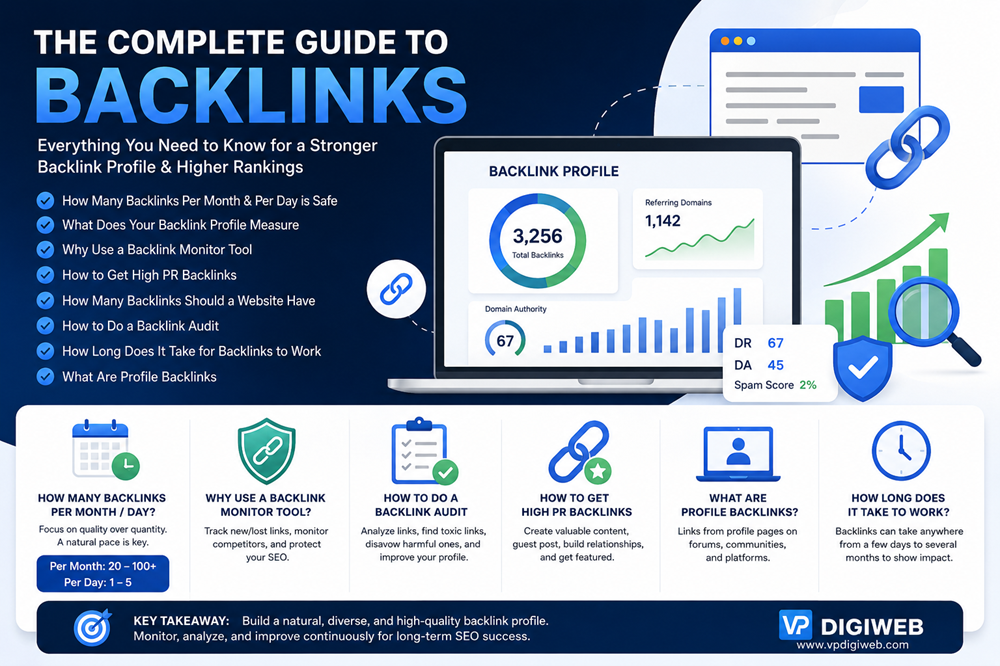
How Many Backlinks Per Month Should You Build?
One of the most common SEO questions is:
“How many backlinks per month are ideal?”
There is no universal number because backlink growth depends on:
- Website age
- Industry competition
- Existing authority
- Content quality
- Competitor backlink velocity
- Niche relevance
- Link quality
- Brand popularity
General Backlink Building Guidelines
New Websites
For new domains, gradual growth works best.
Recommended range:
- 5–20 quality backlinks per month
Focus areas:
- Local citations
- Niche directories
- Foundational links
- Guest posts
- Social profiles
- Business listings
- Contextual niche edits
Medium Authority Websites
Recommended range:
- 20–80 quality backlinks per month
Focus areas:
- Authority guest posts
- Digital PR
- Resource links
- HARO responses
- Editorial mentions
- Industry collaborations
Competitive Niches
Industries like SEO, finance, legal, healthcare, casino, and SaaS may require:
- 100+ high-quality links monthly
But quality matters more than volume.
A natural backlink profile grows steadily over time instead of suddenly receiving thousands of unrelated links.
Important Insight
Google does not punish websites for building many backlinks naturally. The issue happens when links appear manipulated, automated, irrelevant, or spammy.
How Many Backlinks Per Day Is Safe?
Another highly searched question is:
“How many backlinks per day is safe?”
There is no exact safe number.
Google evaluates patterns, not arbitrary daily limits.
Safe Backlink Velocity Depends on:
- Brand popularity
- Viral content
- Industry trends
- Website authority
- Natural mentions
- News coverage
- Content quality
For example:
- A viral article may gain 500 backlinks in one day naturally.
- A new unknown website suddenly getting 10,000 spam links may trigger algorithmic suspicion.
Safe Link Building Practices
Instead of focusing on daily numbers, focus on:
Relevance
Links should come from websites related to your industry.
Quality
High-authority websites carry stronger trust signals.
Diversity
A healthy profile includes:
- Guest posts
- Editorial links
- Citations
- Resource links
- Profile links
- Social mentions
- Niche edits
- Forum references
Natural Anchor Text
Avoid overusing exact match keywords.
Instead of repeating:
- “best SEO company”
Use variations like:
- Brand name
- URL anchors
- Generic anchors
- Partial match anchors
- Natural sentence anchors
Steady Growth
Consistent monthly growth appears more natural than sudden spikes.
Why Use a Backlink Monitor Tool?
Backlink monitoring tools are essential for modern SEO campaigns.
A backlink profile changes constantly.
Links can:
- Get removed
- Become nofollow
- Turn toxic
- Lose indexation
- Redirect incorrectly
- Break due to website updates
Benefits of Backlink Monitoring Tools
Track New Backlinks
You can identify which campaigns generate links.
Detect Toxic Links
Spam links may hurt trust signals.
Monitor Competitors
You can discover competitor link opportunities.
Measure Link Growth
Understanding backlink velocity helps SEO planning.
Recover Lost Links
Sometimes high-authority links disappear after site updates.
Improve SEO ROI
Monitoring helps determine which link-building strategies actually improve rankings.
Popular Backlink Monitoring Tools
- Ahrefs
- SEMrush
- Majestic
- Moz
- Google Search Console
- SE Ranking
- Ubersuggest
At VP DigiWeb, backlink monitoring is a core part of ongoing SEO maintenance because rankings can fluctuate when valuable links are lost.
What Does Your Backlink Profile Measure?
Your backlink profile represents the complete collection of links pointing to your website.
Search engines evaluate this profile to determine:
- Authority
- Trustworthiness
- Relevance
- Popularity
- Expertise
- Link quality
Key Metrics in a Backlink Profile
Referring Domains
The number of unique websites linking to you.
Generally, 100 links from 100 websites are stronger than 100 links from one website.
Domain Authority or Domain Rating
Third-party metrics estimating website authority.
Topical Relevance
Links from industry-related websites carry more value.
Anchor Text Distribution
Search engines analyze whether anchors appear natural.
Follow vs Nofollow Links
A healthy profile contains both.
Link Placement
Contextual editorial links usually perform better than footer or sidebar links.
Link Freshness
Consistent acquisition signals active brand growth.
Toxicity Signals
Spammy or manipulative links may weaken trust.
What a Healthy Backlink Profile Looks Like
A strong profile usually includes:
- Relevant industry links
- Brand mentions
- Diverse anchors
- Natural growth
- Editorial references
- Authority domains
- Local citations
- Mixed link types
How to Get High PR Backlinks
The term “PR backlinks” originally referred to Google PageRank.
Today, people use it to describe high-authority backlinks from trusted websites.
Effective Ways to Get High-Authority Backlinks
Create Link-Worthy Content
High-quality content naturally attracts links.
Examples:
- Research studies
- Industry statistics
- Ultimate guides
- Case studies
- Original data
- Infographics
- Tools and calculators
Guest Posting
Contributing valuable articles to relevant websites remains effective.
Focus on:
- Industry relevance
- Traffic quality
- Editorial standards
- Real audiences
Digital PR
PR campaigns help secure mentions from news sites and publications.
HARO and Journalist Requests
Providing expert insights can earn editorial mentions.
Broken Link Building
Find broken links on authority websites and suggest your content as replacement.
Resource Page Outreach
Many websites maintain curated resource pages.
Build Topical Authority
Websites covering topics comprehensively often attract backlinks naturally.
What to Avoid
Avoid:
- Spam PBNs
- Automated backlinks
- Link farms
- Irrelevant directories
- Paid spam links
- Mass comment spam
These tactics may cause ranking instability.
How Many Backlinks Should a Website Have?
Another common misconception is that websites need a specific number of backlinks.
The real answer:
You Need More Quality and Authority Than Competitors
SEO is comparative.
If top-ranking competitors have:
- 50 strong referring domains
You may need:
- Better content
- Stronger authority
- More topical relevance
- Higher-quality backlinks
—not necessarily thousands more links.
Backlink Quantity Benchmarks
Local Businesses
Often rank with:
- 20–100 quality referring domains
Medium Businesses
Usually require:
- 100–500 quality domains
National Competitive Niches
Can require:
- Thousands of authority links
But again, quality and relevance matter far more.
We have seen websites outrank competitors with fewer backlinks because their topical authority and content quality were significantly better.
How to Do a Backlink Audit
A backlink audit helps evaluate the quality and health of your link profile.
Regular audits are important for:
- Preventing spam issues
- Improving authority
- Recovering rankings
- Identifying negative SEO
- Maintaining trust signals
Step-by-Step Backlink Audit Process
Step 1: Export Your Backlinks
Use tools like:
- Google Search Console
- Ahrefs
- SEMrush
- Majestic
Step 2: Analyze Referring Domains
Check:
- Relevance
- Traffic quality
- Spam indicators
- Indexation
- Authority
Step 3: Review Anchor Text
Look for:
- Over-optimized exact match anchors
- Unnatural repetition
- Spam anchors
Step 4: Identify Toxic Links
Warning signs include:
- Gambling spam
- Adult spam
- Foreign language spam
- Automated links
- Malware domains
- Deindexed websites
Step 5: Check Link Placement
Editorial contextual links are usually strongest.
Step 6: Compare Competitors
Understand what authoritative links competitors have.
Step 7: Remove or Disavow Harmful Links
In severe cases, use Google’s Disavow Tool carefully.
Signs You Need a Backlink Audit
- Ranking drops
- Traffic decline
- Manual action warnings
- Spam link spikes
- Negative SEO concerns
- Large-scale previous link building
At VP DigiWeb, backlink audits often reveal that poor-quality historical SEO campaigns caused long-term ranking limitations.
How Long Does It Take for Backlinks to Work?
Backlinks rarely impact rankings instantly.
Search engines require time to:
- Crawl links
- Index pages
- Evaluate authority
- Process relevance
- Measure trust signals
Average Timeline for Backlink Impact
Low Competition Niches
Possible impact:
- 2–6 weeks
Medium Competition Niches
Typical impact:
- 2–4 months
High Competition Niches
May require:
- 6–12 months
Factors Affecting Backlink Speed
Website Authority
Established domains respond faster.
Link Quality
Strong editorial links often impact rankings more quickly.
Content Quality
Weak content limits backlink effectiveness.
Indexation
If links are not indexed, they provide little value.
Competition
Competitive industries require stronger authority.
Important SEO Reality
Backlinks alone do not guarantee rankings.
Google also evaluates:
- Content depth
- User intent satisfaction
- Technical SEO
- Core Web Vitals
- Topical authority
- Internal linking
- EEAT signals
The best SEO strategy combines all ranking factors.
What Are Profile Backlinks?
Profile backlinks are links created within user profiles on websites, forums, communities, social networks, or business directories.
Examples include:
- Forum profiles
- Social media profiles
- Business listing profiles
- Community websites
- Portfolio websites
- Professional directories
Are Profile Backlinks Good for SEO?
Profile backlinks can help with:
- Link diversity
- Brand indexing
- Citation consistency
- Initial authority signals
- Referral traffic
However, they are usually low-authority compared to editorial contextual links.
Best Use Cases for Profile Backlinks
New Website Foundation
They help establish brand presence.
Local SEO
Business citations improve local trust.
Brand Entity Building
Consistent brand mentions strengthen online identity.
What to Avoid
Avoid:
- Automated profile creation
- Thousands of spam accounts
- Irrelevant forum profiles
- Duplicate descriptions
- Low-quality link farms
Profile backlinks should be part of a diversified backlink strategy—not the entire strategy.
Types of Backlinks That Still Work in Modern SEO
Editorial Links
Natural mentions inside quality content.
Guest Post Links
Relevant contributed content on niche websites.
Resource Page Links
Links from curated informational resources.
Niche Edits
Contextual placements inside existing articles.
Digital PR Links
Mentions from media and news publications.
Local Citation Links
Business directory mentions.
HARO Links
Journalist-source editorial mentions.
Industry Directory Links
Relevant professional directories.
Backlink Mistakes That Hurt Rankings
Buying Bulk Spam Links
Cheap bulk backlinks often create long-term SEO problems.
Overusing Exact Match Anchors
Unnatural anchor optimization can trigger spam signals.
Ignoring Relevance
Relevant links outperform unrelated authority links.
Building Links to Weak Content
Poor content reduces backlink effectiveness.
Using Only One Link Type
Diverse link profiles appear more natural.
Ignoring Technical SEO
Backlinks cannot fully compensate for technical SEO issues.
How VP DigiWeb Approaches Modern Link Building
At VP DigiWeb, backlink building focuses on long-term authority instead of short-term manipulation.
Our approach includes:
- Topical authority content
- Competitor backlink analysis
- Editorial outreach
- Contextual placements
- Link gap analysis
- Local SEO citations
- Digital PR opportunities
- Anchor diversification
- Content-driven acquisition
- Toxic link monitoring
We have consistently observed that websites combining:
- High-quality content
- Strong internal linking
- Technical SEO optimization
- Natural backlink growth
achieve more stable rankings than websites relying only on aggressive link quantity.
Final Thoughts
Backlinks remain one of the strongest SEO ranking factors, but modern SEO requires smarter link-building strategies.
Instead of chasing random backlink counts, businesses should focus on:
- Relevance
- Authority
- Natural acquisition
- Topical trust
- Content quality
- User value
A strong backlink profile grows steadily, supports topical authority, and strengthens overall website trust.
Whether you are building links for a local business, national brand, SaaS platform, eCommerce store, or blog, sustainable SEO success comes from combining valuable content with strategic authority building.
For long-term ranking improvements, backlink quality will always outperform backlink quantity.
Reviewed by: Vicky Patel – SEO Specialist & Founder of VP DigiWeb with 9+ years of experience in SEO and digital marketing.