
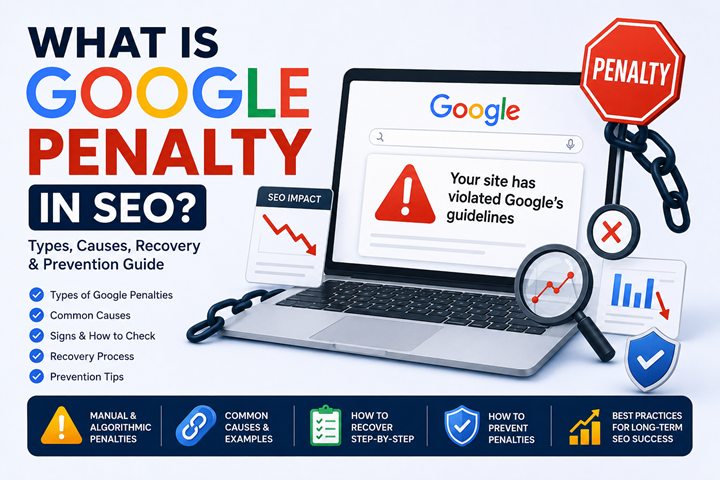
Google penalties are one of the biggest reasons websites suddenly lose rankings, organic traffic, and leads. A website can rank on page one for months and then disappear from search results almost overnight because of a penalty triggered by spam signals, manipulative SEO tactics, or guideline violations.
For businesses investing in SEO, understanding Google penalties is essential to protecting long-term organic growth.
At VP DigiWeb, we have audited websites affected by algorithmic penalties, spam updates, toxic backlinks, thin content issues, and aggressive AI-generated content strategies. In many cases, traffic drops were recoverable after identifying the root cause and rebuilding search trust properly.
This guide explains everything about Google penalties in SEO, including types, causes, examples, recovery methods, and how to avoid penalties in the future.
What Is a Google Penalty?
A Google penalty is a negative impact on a website’s search rankings caused by violating Google’s search quality guidelines.
When Google detects spammy, manipulative, deceptive, or low-quality SEO practices, it may:
- Reduce rankings
- Remove pages from search results
- Deindex an entire website
- Ignore manipulative backlinks
- Lower trust signals across the domain
The result is a sudden drop in organic visibility and traffic.
Google penalties can happen manually by human reviewers or automatically through ranking algorithms.
Types of Google Penalties in SEO
There are two major types of Google penalties:
1. Manual Penalty
A manual penalty happens when a Google reviewer manually checks a website and determines that it violates search guidelines.
Google usually sends a notification inside:
- Google Search Console
Common manual actions include:
- Unnatural backlinks
- Thin content
- Cloaking
- Pure spam
- Hidden text
- AI-generated spam content
- Sneaky redirects
- User-generated spam
Example of Manual Penalty
If a website buys hundreds of keyword-rich backlinks from unrelated blogs, Google may apply a manual action for “Unnatural links to your site.”
2. Algorithmic Penalty
An algorithmic penalty happens automatically when Google’s ranking systems detect low-quality or manipulative signals.
There is no direct notification.
Instead, you may notice:
- Sudden traffic drops
- Keyword ranking losses
- Deindexed pages
- Reduced impressions in Search Console
Algorithmic penalties are usually associated with major Google updates.
Major Google Algorithm Updates Related to Penalties
Google Panda Update
Focused on:
- Thin content
- Duplicate content
- Low-quality articles
- Content farms
Websites publishing shallow SEO articles at scale were heavily affected.
Penguin Update
Focused on:
- Spam backlinks
- Link schemes
- Paid links
- Over-optimized anchor text
This update changed how Google evaluates backlinks.
Helpful Content Update
Focused on:
- Content written only for rankings
- AI-generated spam
- Unhelpful pages
- Poor user experience
Google now prioritizes experience-based, people-first content.
Spam Updates
Google regularly releases spam updates targeting:
- Expired domain abuse
- Parasite SEO
- Scaled content abuse
- Automatically generated spam
- Cloaking
- Hacked pages
Common Reasons Websites Get Google Penalties
1. Buying Backlinks
Purchasing links solely to manipulate rankings violates Google guidelines.
Risky link sources include:
- PBNs (Private Blog Networks)
- Paid guest posts
- Spam directories
- Irrelevant PR links
- Automated backlinks
If done aggressively, rankings can collapse after spam updates.
2. Keyword Stuffing
Overusing keywords unnaturally is still a spam signal.
Bad example:
“Best SEO company in Mumbai offering SEO services in Mumbai for businesses needing SEO company Mumbai.”
Google prefers natural semantic writing.
3. Thin Content
Pages with very little value often struggle after quality updates.
Examples:
- 300-word service pages
- AI-spun articles
- Duplicate city pages
- Empty category pages
4. Duplicate Content
Copying content from other websites or repeating the same content across many pages can reduce trust.
This commonly happens with:
- Ecommerce filters
- Location landing pages
- Auto-generated SEO pages
5. Cloaking
Showing different content to Google and users is considered deceptive.
Examples include:
- Hidden redirects
- Keyword-heavy crawler pages
- Showing different HTML to bots
This can trigger severe penalties.
6. Spammy AI Content
AI content itself is not banned.
However, low-quality AI-generated content made only to manipulate rankings can be penalized.
Google evaluates:
- Originality
- Expertise
- Human value
- Experience signals
- Content depth
7. Hidden Text or Links
Adding invisible keywords or hidden links violates search policies.
Examples:
- White text on white background
- Tiny hidden links
- CSS-hidden keyword blocks
8. User-Generated Spam
Forums, comments, and profile pages with spam links can harm website quality.
This often affects:
- WordPress blogs
- Community sites
- Open forums
9. Hacked Website Issues
If hackers inject spam pages into your website, Google may flag the domain.
Common hacked spam includes:
- Casino pages
- Pharma spam
- Adult redirects
- Japanese keyword hack
10. Poor E-E-A-T Signals
Google increasingly evaluates:
- Experience
- Expertise
- Authoritativeness
- Trustworthiness
Websites lacking trust signals may lose rankings during core updates.
Signs Your Website Has a Google Penalty
Traffic Suddenly Drops
A sharp organic traffic decline in:
- Google Analytics
- Search Console
is often the first warning sign.
Rankings Disappear
Keywords that ranked on page one suddenly drop beyond page five or disappear entirely.
Pages Are Deindexed
Search:
site:yourdomain.comIf important pages disappear, indexing problems or penalties may exist.
Search Console Manual Action Notice
Manual penalties usually appear under:
- Security & Manual Actions → Manual Actions
inside Search Console.
Google Stops Crawling Frequently
Reduced crawl activity can signal lower trust.
How to Check If Your Website Has a Google Penalty
Use Google Search Console
The best place to check for manual penalties is:
Google Search Console Manual Actions Guide
Compare Traffic with Google Updates
Use tools like:
- Semrush Sensor
- MozCast
to compare traffic drops with algorithm updates.
Audit Backlinks
Analyze backlink quality using tools like:
- Ahrefs
- Semrush
Look for:
- Spam anchors
- Toxic domains
- Irrelevant links
- Link velocity spikes
How to Recover From a Google Penalty
Step 1: Identify the Cause
Determine whether the issue is:
- Manual action
- Spam update
- Core update
- Link-related issue
- Content quality problem
Without identifying the real cause, recovery becomes difficult.
Step 2: Remove Toxic Backlinks
For link penalties:
- Remove paid links
- Contact webmasters
- Disavow spam domains carefully
Google’s disavow tool should only be used when necessary.
Step 3: Improve Content Quality
Upgrade weak pages by adding:
- Original insights
- Expert experience
- Statistics
- FAQs
- Examples
- Better structure
- Helpful visuals
Thin content rarely recovers without major improvements.
Step 4: Remove Spam Pages
Delete:
- Auto-generated pages
- Doorway pages
- Duplicate content
- Hacked URLs
Clean indexation improves trust.
Step 5: Fix Technical SEO Issues
Audit:
- Crawl errors
- Index bloat
- Redirect chains
- Canonicals
- Mobile usability
- Core Web Vitals
Technical quality supports recovery.
Step 6: Submit Reconsideration Request
For manual penalties, submit a reconsideration request after fixing issues.
Explain clearly:
- What caused the issue
- What actions were taken
- How future violations will be prevented
How Long Does Google Penalty Recovery Take?
Recovery time depends on the severity of the issue.
Typical timelines:
| Penalty Type | Recovery Time |
|---|---|
| Minor quality issue | Few weeks |
| Spam backlinks | 1–4 months |
| Manual action | Several weeks after reconsideration |
| Core update impact | Until next major reassessment |
| Severe spam abuse | 6+ months |
Some websites never fully recover if trust is deeply damaged.
Can AI Content Cause Google Penalties?
Google does not penalize AI content simply because it is AI-generated.
However, penalties can happen if content is:
- Mass-produced
- Low quality
- Factually weak
- Unhelpful
- Spam-focused
Helpful AI-assisted content combined with human expertise can still rank well.
Are Backlinks Still Dangerous?
Backlinks remain important for SEO, but manipulative link building is risky.
Safe link strategies include:
- Digital PR
- High-quality guest posting
- Resource link building
- Editorial mentions
- Niche-relevant citations
- Brand authority building
At VP DigiWeb, we have seen websites lose rankings after aggressive anchor-text-heavy backlink campaigns from unrelated websites. Modern SEO requires relevance, trust, and natural link acquisition.
How to Prevent Google Penalties
Publish Helpful Content
Focus on:
- User intent
- Originality
- Expertise
- Real experience
Avoid creating pages only for keywords.
Avoid Black Hat SEO
Never rely on:
- Link schemes
- Automated backlinks
- Cloaking
- Spam AI content
- Hidden text
Short-term gains often lead to long-term ranking losses.
Monitor Backlinks Regularly
Track backlink growth and remove toxic patterns early.
Improve E-E-A-T
Strengthen:
- Author profiles
- Brand mentions
- Case studies
- Reviews
- Trust pages
- Expert insights
Maintain Technical SEO
A healthy website improves trust and crawl efficiency.
Regularly audit:
- Indexing
- Speed
- Mobile experience
- Broken pages
- Structured data
Google Penalty vs Google Sandbox
Many people confuse penalties with sandbox effects.
| Google Penalty | Google Sandbox |
|---|---|
| Caused by guideline violations | Temporary trust delay |
| Can affect old websites | Mostly affects new websites |
| Often sudden traffic drop | Slow ranking growth |
| May require fixes | Usually improves with authority |
Real SEO Insight: Why Many Websites Get Penalized Today
Many businesses still follow outdated SEO practices:
- Mass AI content publishing
- Cheap backlinks
- Exact-match anchor spam
- Parasite SEO abuse
- Scaled location pages
Google’s algorithms have become significantly better at identifying manipulation patterns.
In competitive niches, sustainable SEO now depends more on:
- Brand trust
- Content quality
- User engagement
- Topical authority
- Real expertise
rather than shortcuts.
Frequently Asked Questions About Google Penalties
Is Google penalty permanent?
No. Many penalties can be recovered after fixing violations and rebuilding trust.
Can bad backlinks hurt SEO?
Yes, especially if link manipulation is aggressive or unnatural.
Does duplicate content cause penalties?
Not always a direct penalty, but it can dilute rankings and reduce quality signals.
Can negative SEO cause penalties?
In rare cases, massive spam attacks may affect rankings, though Google is better at ignoring spam today.
How do I know if Google penalized my website?
Check:
- Search Console
- Ranking drops
- Traffic decline
- Indexation loss
- Manual action notices
Final Thoughts
Google penalties can severely impact business visibility, traffic, and revenue. Whether caused by spam backlinks, thin content, manipulative SEO tactics, or low-quality AI content, the solution is almost always the same:
- Remove spam signals
- Improve quality
- Build authority naturally
- Focus on long-term trust
Modern SEO is no longer about shortcuts. Websites that consistently publish valuable, experience-driven content and maintain strong technical SEO foundations are far more likely to sustain rankings through future algorithm updates.
For businesses investing in long-term organic growth, understanding Google penalties is no longer optional — it is a critical part of SEO strategy.
Reviewed by: Vicky Patel – SEO Specialist & Founder of VP DigiWeb with 9+ years of experience in SEO and digital marketing.