
If you want better Google rankings, more traffic, and qualified leads, you need to understand the difference between on-page SEO and off-page SEO.
Many businesses invest heavily in backlinks but ignore their website structure. Others publish “SEO optimized” content but never build authority outside their website.
The result?
👉 Rankings stay stuck.
At VP Digiweb, we’ve worked with local businesses, service brands, and ecommerce websites across India. One thing we consistently see is this:
Websites rank faster when strong on-page SEO and strategic off-page SEO work together.
In this guide, SEO expert Vicky Patel breaks down:
- What is on-page SEO
- What is off-page SEO
- On-page and off-page SEO difference
- Off-page SEO meaning in digital marketing
- Best SEO off-page activities
- Modern on-page SEO techniques
- Which matters more in 2026
- Real ranking insights from client campaigns
Modern SEO is no longer just “content vs backlinks.” Search engines now evaluate intent, trust, topical authority, user experience, and brand reputation together.
What Is On-Page SEO?
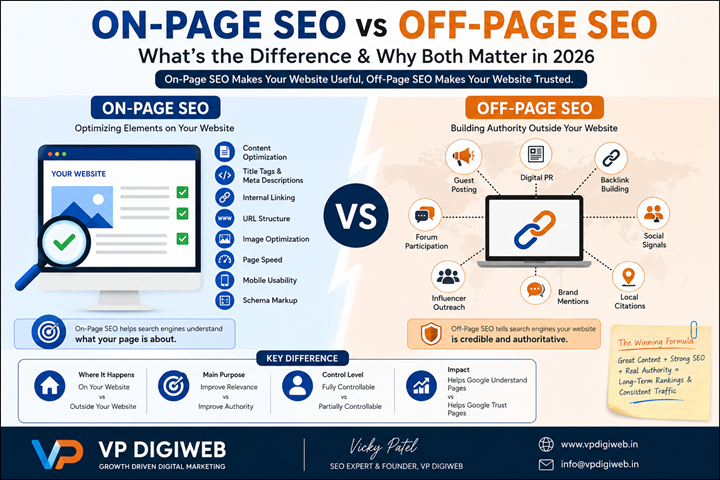
On-page SEO (also called on-site SEO) refers to all the optimizations done inside your website to improve rankings and user experience.
This includes:
- Content optimization
- Keyword placement
- Title tags
- Meta descriptions
- URL structure
- Internal linking
- Image optimization
- Page speed
- Mobile usability
- Schema markup
- Heading structure
In simple words:
On-page SEO helps Google understand what your page is about.
Most modern SEO guides define on-page SEO as everything you can directly control on a webpage.
What Is Off-Page SEO?
Off-page SEO refers to all activities performed outside your website to improve authority, trust, and rankings.
The primary goal of off-page SEO is to show Google that other websites and users trust your brand.
Off-page SEO includes:
- Backlink building
- Digital PR
- Guest posting
- Brand mentions
- Social signals
- Citation building
- Influencer outreach
- Forum participation
- Local SEO citations
- Content promotion
In simple terms:
Off-page SEO tells Google your website is credible and authoritative.
Modern SEO experts now consider off-page SEO as broader than just backlinks. Brand mentions, AI citations, PR signals, and online reputation also influence visibility.
On-Page SEO vs Off-Page SEO: Main Difference
| Factor | On-Page SEO | Off-Page SEO |
|---|---|---|
| Where it happens | Inside your website | Outside your website |
| Main purpose | Improve relevance | Improve authority |
| Control level | Fully controllable | Partially controllable |
| Focus | Content & UX | Trust & popularity |
| Examples | Titles, content, speed | Backlinks, PR, mentions |
| Impact | Helps Google understand pages | Helps Google trust pages |
The biggest difference is:
- On-page SEO improves relevance
- Off-page SEO improves authority
Google uses both signals together to rank websites.
What Is On-Page SEO Techniques?
Here are the most effective on-page SEO techniques in 2026. Businesses, students, and freelancers looking to master these optimization methods often join a professional SEO course in Surat to gain practical implementation experience.
1. Search Intent Optimization
Google prioritizes pages that satisfy user intent.
For example:
- Informational keywords need educational content
- Commercial keywords need service comparisons
- Transactional keywords need landing pages
At VP Digiweb, improving search intent alignment alone helped one Mumbai business move from page 3 to page 1 within 4 months.
2. SEO-Friendly Title Tags
Your title tag directly impacts rankings and CTR.
Example:
Bad:
SEO Services
Better:
SEO Services in Mumbai – Affordable SEO Company | VP Digiweb
3. Proper Heading Structure
Use:
- One H1
- Clear H2s
- Supporting H3s
This improves readability and helps Google understand content hierarchy.
4. Internal Linking
Internal links distribute authority across your website.
One strategy we use at VP Digiweb:
- Link service pages to supporting blogs
- Link blogs back to commercial pages
- Build topical clusters
This improves crawlability and topical authority.
5. Content Depth & Topical Coverage
Thin content rarely ranks today.
Google rewards pages that fully answer the query.
That means covering:
- Definitions
- Benefits
- FAQs
- Examples
- Mistakes
- Comparisons
- Case studies
6. Page Speed Optimization
A slow website increases bounce rate.
Important factors:
- Image compression
- Fast hosting
- Lazy loading
- Core Web Vitals
- Mobile responsiveness
7. Schema Markup
Structured data helps search engines understand your content better.
Useful schemas:
- LocalBusiness
- FAQ
- Article
- Service
- Review
8. Image SEO
Optimize:
- File names
- Alt text
- Image sizes
- WebP formats
What Is Off-Page SEO in Digital Marketing?
Off-page SEO in digital marketing refers to strategies that improve your website’s authority through external signals.
Google interprets quality backlinks and mentions as trust indicators.
However, off-page SEO in 2026 is no longer about mass link building.
According to recent industry discussions, low-quality directories, spammy forums, and irrelevant backlinks have lost most of their effectiveness.
What works today:
- Relevant editorial backlinks
- Digital PR
- High-authority guest posts
- Brand mentions
- Real traffic referrals
- AI citation visibility
- Niche relevance
SEO Off-Page Activities That Still Work in 2026
Guest Posting
Publishing quality content on niche websites still works when done naturally.
At VP Digiweb, we’ve seen strong ranking improvements from:
- Local business blogs
- Industry publications
- Marketing websites
- Startup communities
Digital PR
PR mentions help:
- Build trust
- Increase branded searches
- Earn authoritative links
This is becoming increasingly important for AI search visibility.
Local Citations
Essential for local SEO.
Examples:
- Google Business Profile
- Justdial
- IndiaMART
- Sulekha
- Yelp
Brand Mentions
Google increasingly recognizes unlinked brand mentions as authority signals.
Forum & Community Engagement
Platforms like:
- Quora
- Warrior Forum
can drive referral traffic and brand discovery when used genuinely.
Linkable Asset Creation
Create:
- Research studies
- Statistics pages
- Ultimate guides
- Free tools
- Infographics
These naturally attract backlinks.
Which Is More Important: On-Page or Off-Page SEO?
The answer is:
You need both.
But in most cases:
- On-page SEO comes first
- Off-page SEO amplifies results
Many SEO professionals now agree that backlinks strengthen already good pages rather than ranking weak content alone.
A properly optimized website with no authority may struggle.
A high-authority website with poor content may also struggle.
The winning combination is:
- Strong content
- Excellent UX
- Technical SEO
- Relevant backlinks
- Brand trust
Real SEO Experience from VP Digiweb
At VP Digiweb, we’ve worked on websites where:
Scenario 1: Strong Backlinks, Weak On-Page SEO
The website had:
- Hundreds of backlinks
- Poor content structure
- Thin pages
- No internal linking
Result:
- Rankings fluctuated heavily
- Low conversion rate
After improving:
- Page structure
- Content depth
- Search intent
- Internal links
Traffic improved significantly within months.
Scenario 2: Great Content, No Off-Page SEO
Another client had:
- Excellent service pages
- Strong UX
- Good technical SEO
But almost no backlinks.
Result:
- Stuck on page 2
After targeted:
- Guest posting
- Niche backlinks
- Local citations
- PR mentions
The site started ranking in top 5 positions.
Common SEO Mistakes Businesses Make
Focusing Only on Backlinks
Many agencies still sell bulk backlinks.
In 2026, relevance matters far more than volume.
Ignoring Search Intent
Ranking fails when content doesn’t match user expectations.
Thin Content
Short pages with little value rarely compete today.
Poor Internal Linking
Without internal links:
- Authority flow weakens
- Crawlability suffers
- Pages remain isolated
Over-Optimized Anchor Text
Excessive exact-match anchors can look manipulative.
Best SEO Strategy for 2026
The most effective SEO strategy today combines:
On-Page SEO
- Intent-focused content
- Topic clusters
- UX optimization
- Technical improvements
PLUS
Off-Page SEO
- Relevant backlinks
- Brand mentions
- Digital PR
- AI visibility building
This balanced approach creates long-term rankings instead of temporary spikes.
Final Thoughts
Understanding the difference between on-page SEO and off-page SEO is essential for sustainable rankings.
Here’s the simplest way to think about it:
- On-page SEO makes your website useful
- Off-page SEO makes your website trusted
Neither works effectively alone.
At VP Digiweb, we focus on combining:
- Search intent optimization
- Technical SEO
- High-quality content
- Strategic link building
- Brand authority
to help businesses achieve long-term organic growth.
As search engines continue evolving with AI-driven results, websites that combine helpful content + real authority will continue winning rankings.
FAQs
What is the difference between on-page and off-page SEO?
On-page SEO involves optimizing elements inside your website, while off-page SEO focuses on external authority signals like backlinks and brand mentions.
What is off-page SEO?
Off-page SEO includes activities done outside your website to improve trust, authority, and rankings.
What is on-page SEO?
On-page SEO refers to optimizing content, structure, and technical elements within a webpage to improve rankings.
Which is more important: on-page or off-page SEO?
Both are important. On-page SEO builds relevance, while off-page SEO strengthens authority.
What are off-page SEO activities?
Common off-page SEO activities include guest posting, digital PR, backlinks, citations, social sharing, and brand mentions.
What are on-page SEO techniques?
Important techniques include keyword optimization, internal linking, schema markup, title optimization, content structuring, and page speed improvements.
Reviewed by: Vicky Patel – SEO Specialist & Founder of VP DigiWeb with 9+ years of experience in SEO and digital marketing.